
AI Voice Agent for Service Businesses
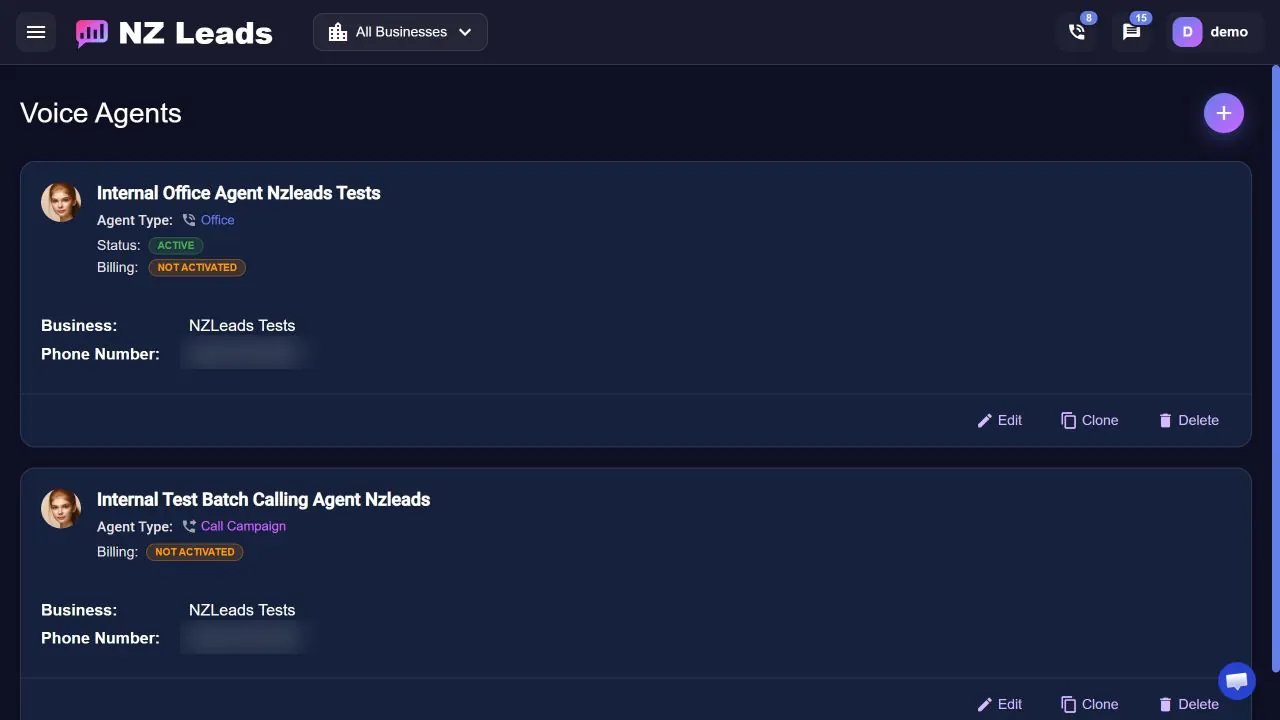
An AI voice agent for business is software that handles phone calls for you: it answers inbound calls, calls new leads back the instant they arrive, asks the qualifying questions, and books the job into your calendar. For a service business it costs $10/month per number plus $1 per minute of talk time, with no contracts and a 7-day free trial.
This is part of our complete AI Voice Agent guide for service businesses.
The pricing is simple: $10/month per number + $1/minute of talk time. The math is simpler: one recovered call covers the whole month. Deploy by tonight.
Want voice on your phone line by morning? Try NZ Leads free and run your first test call in minutes.
What Does an AI Voice Agent Do for a Business?
A business uses an AI voice agent in three ways, and each one is its own agent type. This guide is mostly about the first two.
| Agent type | What it does | Typical use |
|---|---|---|
| Answering agent | Takes inbound calls to your business: answers questions from your own information, quotes from your price list, and books appointments. | Calls you miss while on a job, after hours, or while you are on another call. |
| Calling agent | Calls each new lead from a connected source the instant the lead is created, for example a Facebook Lead Ads form or a Google Local Services Ads lead. | Reaching a form or marketplace lead while they are still looking. |
| Batch calling agent | Runs an outbound campaign to a list, personalized for each person on it. | Campaigns to a list you supply, such as maintenance reminders. |
A Yelp lead gets a callback only once the customer shares a phone number on Yelp; until then, the conversation stays in Yelp’s messages.
What happens on every call
| Step | Action |
|---|---|
| 1. Picks up | Instantly, every call |
| 2. Greets | Under 15 words, business name and first name |
| 3. Listens | Real-time transcription |
| 4. Quotes | Pulls pricing from your service list |
| 5. Books | Live calendar slot, real time |
| 6. Confirms | SMS to customer, notification to you |
| 7. Records | Full audio + transcript to CRM |
A 90-to-180-second call, a couple of dollars in talk time, one booked job.
How Much Does an AI Voice Agent Cost for a Business?
What the agent actually costs.
| Item | Cost |
|---|---|
| Base | $10/month per number |
| Per minute of talk time | $1/minute (rounded up to the next whole minute per call) |
| Setup, support, config changes | Free |
| Recording, transcript, CRM sync | Included |
A call that runs 90 to 180 seconds is billed as 2 to 3 minutes, or $2 to $3 in talk time. No contracts, no minimums, 7-day free trial.
Per-call economics
A single call costs about the price of a coffee, and a booked service job is worth hundreds. That gap is why the math works for solo operators: even one booked job from a call you would otherwise have missed pays for far more than a month of talk time.
| Item | Example Value (use your own numbers) |
|---|---|
| Call duration | 90 to 180 seconds |
| Talk-time cost per call | $2 to $3 |
| Service job value | $300 to $500 |
The agent answers calls you would have missed, so the upside is the work you were losing to voicemail.
Break-even by average job value
One booked job covers the month. The higher your average job value, the faster a single recovered call pays for the agent.
| Average Job Value | What One Booking Covers |
|---|---|
| $200 | Multiple months of typical talk-time cost |
| $400 | A full month and then some |
| $800 | Well over a month |
| $2,000+ | Many months from a single call |
The first recovered call can cover the cost the same day.
Is an AI Voice Agent Worth It for a Service Business?
Solo operators miss calls because they are on the truck, under the sink, or driving. Those missed calls are the leak. Acting as an always-on AI answering service, the voice agent answers every one of them, including after hours and during volume spikes, and qualifies the job before the customer moves on to the next business.
Research on speed-to-lead is consistent: contacting a lead within an hour makes you about 7x more likely to qualify it than waiting an hour later, and roughly 60x more likely than 24+ hours (HBR, 2011). Separately, MIT found that waiting from 5 to 30 minutes makes you 21x less likely to qualify a lead and 100x less likely to contact it (Oldroyd, 2007). An instant AI pickup sits at the top of that curve on every call; a missed call sits at the bottom.
It is less of a fit when you rarely miss a call, or when most of your calls are long technical conversations that only you can have. In that case, start with the answering agent on overflow only and look at what it caught after a month.
Which Calls Should the AI Handle, and Which Should Reach You?
Let the agent take the routine calls and decide in writing which ones come to you. Transfer rules are plain sentences, and the agent transfers only when one of them is met.
| Call | Let the AI handle it | Send it to a person |
|---|---|---|
| Price question on a listed service | Yes, from your price ranges | |
| Booking or rescheduling | Yes, into open calendar slots | |
| Gas leak, water damage, or another safety emergency | Yes: write it as a transfer rule | |
| Custom quote, technical troubleshooting, billing dispute | Yes, or a structured message with the full context | |
| Caller who insists on a manager after the agent offers to help | Yes, if your rules allow it |
A transfer can be cold, where the caller goes straight to your number, or warm, where the agent first briefs the person who picks up and then connects the caller. With transfers switched off, the agent offers to help directly and, if the caller insists, takes a message with their contact details. Every call, transferred or not, lands in your call log with a recording, a transcript, and a short summary that says whether a human follow-up is needed. The call transfer guide shows each setting.
How Does an AI Voice Agent Sound to Your Customers?
You choose a name, a voice, and a tone, and you can preview each voice before you commit. The agent never claims to be human: on an outbound call its first sentence introduces it as an AI assistant from your business, and on any call it answers honestly when someone asks whether it is an AI or whether the call is recorded.
Two settings make the biggest difference to how callers react. A short greeting keeps the caller talking instead of waiting. And on callbacks, a verified caller ID lets the agent show your real business number instead of an unfamiliar one, so the lead recognizes who is calling.
How Do You Set Up an AI Voice Agent?
- Sign up and forward your business phone line. After 4 rings.
- Configure the greeting under 15 words. Business name + first name + question.
- Paste your service list with price ranges. Min and max per service.
- Sync your calendar for live booking. Google Calendar or Cal.com.
- Run a test call and go live. Tweak tone, flip live.
Same-day deploy is the norm.
Pick the forwarding rule that matches how your phone is answered today:
- A team that answers most calls: forward on no answer after 3 to 4 rings, so only the calls nobody picks up reach the agent.
- One person who is often on another call: combine forward-when-busy with forward-on-no-answer.
- After-hours or out-of-office cover only: forward every call for those hours.
Frequently Asked Questions
How much does an AI voice agent cost per call?
Pricing is $10/month per number plus $1 per minute of talk time, rounded up to the next whole minute per call. A call that runs 90 to 180 seconds is billed as 2 to 3 minutes, or $2 to $3 in talk time. There are no setup fees, no contracts, and no minimums, plus a 7-day free trial.
What is the ROI of an AI voice agent?
The agent answers and qualifies calls you would otherwise miss while on a job, so the value is the booked work you were losing to voicemail. At $10/month per number plus $1/minute, a single recovered job at typical service-business value covers the cost for the month. The exact return depends on your call volume, average job value, and how many calls you currently miss.
How fast does an AI voice agent pick up the phone?
Instantly. The agent answers on every call, including 3am Saturday. A human receptionist misses calls during peak windows and after hours.
Can the AI voice agent be deployed in under 24 hours?
Yes, same day. Setup takes minutes: sign up, configure the greeting and service list, sync your calendar, and run a test call to confirm it works. You can be taking real calls the same day you sign up.
Does the AI voice agent recover missed calls?
Yes. When a call rings out (you missed it), the platform fires an SMS text-back in under 2 seconds and an optional voice agent callback. Instead of a voicemail the customer never returns, the conversation continues automatically and books the job.
What is the break-even on an AI voice agent?
One booked job. If your average job is worth a few hundred dollars, a single recovered call can cover a full month of voice agent cost. Everything beyond that first recovered job is upside on top of your existing baseline.
How does the AI voice agent handle complex calls?
For straightforward calls (booking, pricing, scheduling), the AI closes the call directly. For complex calls (custom quotes, technical troubleshooting, billing disputes), the agent takes a structured message with full context and texts you the summary so you can step in informed.
Does the AI voice agent work for emergency trades?
Best fit. Emergency trades like plumbing leaks, HVAC outages, locksmith and roof leak response benefit most because customers are ready to book the first business that picks up. Research on speed-to-lead shows contacting within an hour makes you about 7x more likely to qualify a lead (HBR, 2011), and an instant pickup beats every manual response window.
Take Real Calls by Tonight
Try NZ Leads free and put the voice agent on your phone line in minutes. For the missed-call recovery flow, see missed call text back for Yelp and Thumbtack leads. If you are still deciding between a person and software, the comparison of a receptionist vs an AI voice agent covers the trade-offs.